
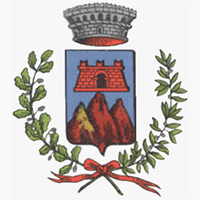
Ubicato in una piccola insenatura della zona meridionale del Lago Maggiore, Lesa è un rinomato centro turistico e di soggiorno. Il paese, citato già in un documento del 998, fu nel XIII secolo corte feudale di giustizia dell'arcivescovo di Milano, fino a quando, con gli altri comuni del Lago Maggiore, diverrà feudo prima dei Visconti e poi dei Borromeo (sotto questi ultimi, sarà capoluogo dei 36 comuni del Vergante).
Located in the southern part of Lake Maggiore, Lesa is a popular tourist center. The country, already mentioned in a document of 998, was in the thirteenth century feudal court of justice of the archbishop of Milan, until, with the other municipalities of Lake Maggiore, will become Visconti feud and then Borromeo feud (then Lesa will be the capital of the 36 Vergante towns).
| Abitanti/Inhabitants number: 2153 |
Superficie/Surface: kmq: 12,49 |
Altitudine sul mare/Altitude: 198 m |
| Denominazione degli abitanti/Inhabitants: lesiani |
Altre località/Towns: Calogna, Comnago, Solcio di Lesa, Villa Lesa |
Cascine/Farms: |
| Festa patronale/Patrons: S. Martino (november); Sant'Antonio (february) S. Bartolomeo (august) |
Telefono/Phone: Prefisso 0322 |
Codice Postale/Postal code: 28040 |
The parish church dedicated to St Martin overlooks the lake. The church is mentioned in a document from 1224, an agreement signed by the arcibishop of Milan and the local lords. The interior has a nave and two aisles; the bell tower is Romanesque, as well as a stone head decorating a pew and the architectural fragment surmounting the stoup. The sumptuously decorated interior testifies to the wealth of the leading families of the town in past centuries.
The parish church of Villa Lesa, dedicated to St George and St John the Baptist, was built from 1764 to 1774. It includes a chapel, built on the remains of the ancient church os St George. The imposing Baroque building has a single nave. The beautiful altar is ornamented by a balaustrade and by a small dome with the statue of St John. The remina of the ancient church are remarkable and include the Romanesque bell tower, dating from the first half of the 11th century; it has five storied decorated with blind arches, arched windows and gemel windows. The portal opening on to the ancient chapel is made of Angera stone, and features a lunette with a relief depicting St George killing the Dragon. Behind the altar is a Crucifixion dating, from 1553 and recently restored; it was painted by Giovanni Maria de Rumo, an artist related to the school of Gaudenzio Ferrari.
The small church dedicated to St Sebastian is perched on a small hill standing not far from town, along the road leading to Massino Visconti. The chapel is documented as far back as the end of the 12th century, and the construction can be dated from the period 1100-1125, as confirmed by the stonework of the masonry. The church has a single nave with semicircular apse and a gabled façade. The bell tower is noteworthy; attached to the church wall, it stands on two pillars visible on the interior of the church. The bell tower has three stories, decorated with blind arches. The openings are of different design: a narrow window on the first story, an arched window with archivolt on the second story, a gemel window with archivolt on the third. The apse, ornamented with irregular blind arches, is divided by three pilasters and features three small splay windows. The apse features an unusual cross-shaped opening, having on the interior a fresco representing Christ as Light and two lambs. The apse walls are decorated with frescoes of modest value, dating from the 15th and 16th centuries and depicting Christ Pantocrator with the symbols of the Evangelists and some saints.
This villa, standing along the northern part of the lakeside promenade, houses today the offices of a bank. Built in the late 18th century in the Neo-classical style, the villa was originally laid on a U plan: in 1806 the two lateral wings were demolished to allow the construction of the road to the Sempione. Alessandro Manzoni used to stay in this elegant residence, after his second marriage to Teresa Borri, widowed Stampa. The famous writer is celebrated in the sala Manzoniana on the interior of the palace, where are displayed drawings, objects, and manuscripts which belonged to Manzoni himself or to his many friends, who often stayed at the villa.
The ruins of this ancient fortified building lie along the shore of the lake and are commonly named the “Castellaccio”. Few and uncertain are the documents on both the origins of the castle and the reasons for its neglect. Due to its location, the castle is supposed to have been used as a watchtower and for the control the trades and the collection of tolls. The remains include a square building and a ruined angular tower.
This small oratory dates from the 17th and 18th centuries. It is a single-nave building, and the façade features a loggia with four columns. Tha small bell tower has a belfry. On the interior are some notable Baroque frescoes.
Photogallery


